Quick Answer
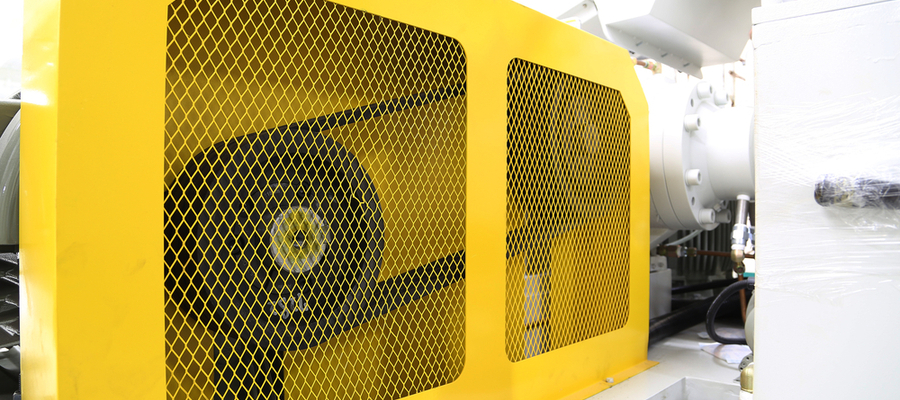
Machine guarding is a structural safety enclosure that prevents operator contact with moving or hazardous parts of industrial machinery, robot cells or automation lines. KM Engineering fabricates modular machine guarding in Faridabad from welded steel frames with mesh or solid panel infill, interlocked access doors per ISO 14120, and powder-coated safety-yellow finish — supplied as kit form for on-site assembly or fully installed.
What Is Machine Guarding?
Machine guarding refers to the physical safety structures — fences, panels, covers, and interlocked doors — installed around industrial machinery to prevent inadvertent operator contact with moving parts, pinch points, laser/welding arc exposure, and ejected debris. Under Indian Factories Act and global standards like ISO 14120 and ANSI B11.19, machine guarding is mandatory on hazardous machinery.
KM Engineering designs and manufactures modular machine guarding systems for manufacturing plants across India — automation robot cells, press-shop hydraulic presses, CNC machining centers, conveyor and transfer lines, welding robot cells, palletizing systems, and packaging automation. Guards are built from fiber-laser-cut steel-tube frames with your choice of steel-mesh (25×25 mm or 40×40 mm) or solid sheet infill panels.
Our systems support standard 50×50 mm or 60×60 mm frame profiles, allowing modular assembly with common panel widths (500, 800, 1000, 1200, 1500 mm). Access doors include mechanical or electrical safety interlocks (Pilz / Euchner / Omron / Schmersal compatible) to meet ISO 14119 interlocking-device requirements. All guarding is powder-coated in safety-yellow RAL 1023 by default, with other RAL and two-tone options available.
Detailed Specifications
Full technical specifications for Machine Guarding — material grades, tolerances, process capabilities, and standards compliance.
| Specification | Value / Description |
|---|---|
| Frame Material | IS 1161 ERW structural tube, 50×50×2.0 mm or 60×60×2.5 mm |
| Post Anchoring | Baseplate 6–10 mm with M12/M16 chemical anchors to floor |
| Mesh Option | Welded mesh 25×25 mm or 40×40 mm from 2 mm galvanized wire |
| Solid Panel Option | CRCA 1.5 / 2.0 mm with perforated vision slots if required |
| Polycarbonate Vision Panels (option) | 6 mm clear polycarbonate for visibility over hazardous areas |
| Standard Panel Widths | 500 / 800 / 1000 / 1200 / 1500 mm |
| Standard Panel Heights | 1800 / 2000 / 2200 / 2400 mm |
| Post Profile | Aluminum extrusion (option) or steel tube |
| Fasteners | M8 captive-nut + hex socket for panel-to-post connection |
| Door Types | Hinged (single / double), sliding (manual / pneumatic), roll-up, interlocked |
| Safety Interlocks | ISO 14119 aligned — Pilz, Euchner, Schmersal, Omron compatible mounting |
| Emergency Stop Integration | Cable gland provisions for E-stop wiring through frame |
| Finish | 7-tank pre-treatment + powder coat 60–80 µm |
| Standard Color | Safety Yellow RAL 1023 (frame), Black RAL 9005 (mesh) |
| Optional Colors | Any RAL; two-tone machine-specific branding |
| Standards Alignment | ISO 14120, ISO 14119, ANSI B11.19, Factories Act |
| Load Rating (perimeter) | 100 N/m² distributed wind-load for indoor use; 750 N lateral impact tolerance |
Manufacturing Process
How KM Engineering fabricates Machine Guarding — step-by-step process from drawing review to dispatch.
Site Survey & Layout Design
On-site or drawing-based survey of machine footprint, operator access points, pedestrian paths, maintenance access, and emergency egress. Layout drawing issued in 2D with panel counts, door locations, interlock points.
Panel & Frame Fabrication
ERW tubes laser-cut to length; mesh panels welded or purchased pre-manufactured; CRCA solid panels fiber-laser cut. Frame corners mitered 45° and TIG-welded for cosmetic joints, MIG-welded on structural joints.
Door Assembly
Hinged doors built with continuous piano hinges; sliding doors assembled on top-track guides; interlock mounting tabs welded to door edge per Pilz/Euchner/Schmersal drawing.
Surface Prep & Coating
7-tank pre-treatment, powder-coat application, cure at 180 °C. Safety Yellow RAL 1023 default; custom colors applied as per order.
Kitting & Packing
All frame posts, horizontal rails, panels, door hardware, interlock brackets, fasteners, anchor bolts kitted per layout drawing. Bill of materials included with each shipment.
Delivery & Site Assembly
Components delivered to customer site on pallets. Optional: our installation team travels for turnkey assembly including floor-anchor drilling, panel erection, door alignment, interlock commissioning. Typical install: 50-m perimeter in 2 working days.
Interlock Commissioning & Handover
Safety interlocks wired by customer's electrical team (our scope ends at mechanical mounting). Joint walk-through to verify panel-to-panel gaps (< 8 mm), door swing, and visibility of E-stops.
Request a Quote for Machine Guarding
Share your drawings or requirements — we respond within 24 hours with a DFM review and priced offer.
Standards & Compliance
KM Engineering manufactures Machine Guarding in alignment with the following Indian and international standards:
- ISO 14120 — General requirements for design and construction of guards
- ISO 14119 — Interlocking devices associated with guards
- ISO 13857 — Safety distances to prevent hazard zones being reached
- ANSI B11.19 — Performance requirements for safeguarding
- Factories Act 1948 — Indian regulatory framework for machine safety
- IS 15354 — Industrial safety fences reference
Industries & Applications
Machine Guarding by KM Engineering is used across multiple Indian industries. Below are typical buyers, their applications, and why they choose us:
Robotic Welding & Assembly Cells
Application: Perimeter fencing around 6-axis welding robots, KUKA/ABB/Fanuc/Kawasaki cells
Why KM: Modular expansion as production grows; interlocked service doors; high-visibility safety yellow + vision panels
Press Shops & Stamping Lines
Application: Guarding around mechanical and hydraulic presses, transfer lines, feed-coil straighteners
Why KM: Heavy 60×60 frame with solid bottom panels and mesh upper; interlocked access for die changes
CNC Machining Cells
Application: Guarding around large horizontal machining centers, bed mills, and gantry routers
Why KM: Polycarbonate vision panels for operator visibility; quick-service sliding doors
Packaging & Palletizing Lines
Application: Perimeter around palletizer cells, case-packers, shrink-wrap tunnels
Why KM: Conveyor cut-outs with operator-safety bypass interlock; hygienic finish for food plants
Laser-Cutting / Plasma Cell Guarding
Application: Enclosure around fiber-laser cutting machines, CO₂ lasers, plasma tables
Why KM: Solid steel panels (no mesh) to contain laser reflections; interlocked sliding door
Warehouse AMR & AGV Zones
Application: Perimeter designation for autonomous mobile robot zones in warehouses
Why KM: Lower-height barrier guards (1000–1400 mm) with high-visibility marking for operator zone separation
Customization Options
Every Machine Guarding we fabricate is made to the customer's drawing or specification. Customizable aspects include:
- Panel widths and heights — any OEM or site-specific dimension
- Infill — mesh, solid, polycarbonate vision, perforated, or combination
- Post profile — steel tube or aluminum extrusion (T-slot)
- Frame color — safety yellow default, any RAL or two-tone
- Door types — hinged, sliding, bi-fold, roll-up
- Interlock brand — Pilz, Euchner, Schmersal, Omron, Keyence — mounting-bracket-ready
- E-stop pedestals, safety-light-curtain integration brackets
- Floor-track sliding door kits for heavy industrial use
- Mobile / casterable guarding sections for line changeover
Quality Assurance & Testing
Each Machine Guarding undergoes the following QC steps as part of our ISO 9001:2015-aligned quality system:
- Frame weld visual inspection per IS 7215
- Panel-to-post fit verified — gap ≤ 8 mm per ISO 13857
- Door swing and close-gap verification
- Powder-coat thickness and adhesion (ASTM D3359) per batch
- Anchor-pull test (on request) — 5 kN tensile on M12 chemical anchor
- Interlock mounting-dimension verification against Pilz/Euchner spec sheet
- Final walk-through at customer site (turnkey install option)
How We Compare
Here is how KM Engineering's Machine Guarding compares against alternative supplier options available to Indian buyers:
| Criterion | KM Engineering | Imported Modular (Axelent / Troax) | Local Welded Fabricator |
|---|---|---|---|
| Modularity | Fully modular, field-expandable | Catalog modular (T-slot) | Fully custom welded |
| Cost (per m² of perimeter) | INR 3,500 – 5,500 | INR 8,000 – 14,000 | INR 4,500 – 7,000 |
| Lead Time | 3–4 weeks | 4–8 weeks (import) | 3–5 weeks |
| Install Support | Optional turnkey install | Support via local partner | Customer-managed |
| ISO 14120 Alignment | Standard design | Standard | Varies |
| Interlock Integration | Multi-brand bracket support | Brand-specific kits | Custom-welded tabs |
Ordering & Lead Time
Frequently Asked Questions
Do your guards meet ISO 14120 and ANSI B11.19?
Yes. Our modular guarding system is designed to meet ISO 14120 general requirements and ISO 13857 safety-distance requirements. Reach-through gap sizing, panel heights, and anchoring loads follow these standards. We provide design documentation for your plant's machine-safety file.
Can you install on-site or only supply in kit form?
Both. Default supply is in kit form with drawings, kitted hardware and site-assembly instructions. Turnkey installation (site travel, anchor drilling, erection, door alignment, handover) is available as an add-on — typical install crew covers 50 linear meters in 2 working days.
What interlock brand do you support?
Our mounting brackets support Pilz PSENsgate/PSENsl, Euchner TZ/TP/TX, Schmersal TESK/AZM, Omron D40A, Sick i10/i110, and Keyence GS-M series. For other brands, share the specific interlock drawing and we'll CAD-match the mounting pattern.
Mesh vs solid panel — which do I choose?
Mesh (25×25 mm or 40×40 mm) is standard for general robot cell and machine perimeter guarding — low cost, high visibility, good airflow. Solid CRCA panels are required for laser/plasma cells (to contain stray radiation), press shops (to contain ejected parts), and where dust containment matters. Polycarbonate vision panels are added when operators need to observe the process.
What's the minimum gap between panels and around the base?
Panel-to-panel gaps are held to < 8 mm per ISO 13857 (to prevent finger reach-through for upper-limb hazards). Ground clearance at the base is < 180 mm by default, or < 120 mm where lower-limb reach is a concern. Custom gap requirements can be addressed at the layout stage.
Can the guarding be relocated when the line is reconfigured?
Yes — and this is a key advantage of our modular design. Panels are bolted to posts (not welded), and posts are anchored with chemical anchors that can be drilled out and re-anchored at a new location. Typical reconfiguration for a 50-m perimeter: 1–2 days for a 3-person crew.
Do you supply safety light-curtain integration?
Yes — we fabricate the mounting columns, post-mount brackets, and wiring conduits to integrate OMRON/Sick/Keyence safety light curtains with our perimeter. The electronics and commissioning are handled by the customer's safety-systems integrator.
What about heavy impact rating — can your guards contain ejected parts from a press?
Standard guard panels (1.5–2.0 mm CRCA) tolerate 750 N lateral impact per our internal test. For high-energy impact from large presses or heavy robots, we supply reinforced heavy-duty guards (3–5 mm solid panels, 80×80 tube frame, reinforced base). Share the specific hazard and we'll engineer to the required impact rating.
Do you do maintenance access platforms and stairs along with guarding?
Yes. Elevated maintenance platforms, stairs, handrails, toe boards, and access gates with interlock integration are all within our fabrication scope — often supplied as part of a complete machine-safety package.
Related Products
Other products frequently considered alongside Machine Guarding:
Ready to Source Machine Guarding?
Share your drawings or requirements with KM Engineering. Our Faridabad team responds within 24 hours with a DFM review, lead time and priced offer.