Quick Answer
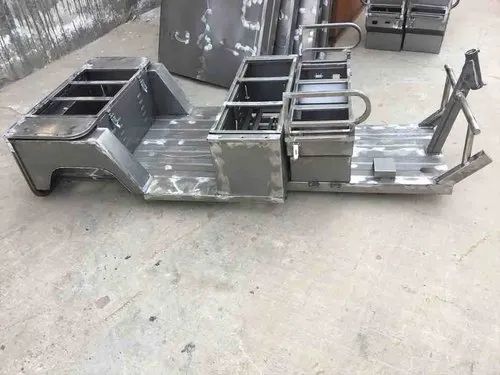
An e-rickshaw passenger chassis is a welded steel frame designed to carry 4–6 passengers, driver, battery pack and drivetrain in an electric auto-rickshaw. KM Engineering fabricates passenger chassis in Faridabad using jig-welded IS 2062 channel and IS 1161 ERW tube, with CED primer plus powder coat finish — lower-rail variants for easy passenger ingress, 20-day lead time, and 25-unit MOQ.
What Is E-Rickshaw Passenger Chassis?
An e-rickshaw passenger chassis is the welded steel framework that supports a 4 to 6-seater electric auto-rickshaw. It carries the driver, two-bench or bucket-seat passenger layout, overhead canopy, battery pack, motor and drivetrain — and is engineered for comfortable passenger ingress, low floor height, and stable cornering behavior in dense urban traffic.
KM Engineering fabricates passenger chassis with lower step-in rail height (design target 300–360 mm) and optimized rear-axle positioning to preserve legroom. Main members are IS 2062 E250 channel with IS 1161 ERW tube cross-members; all welding performed on dedicated chassis jigs to maintain geometric repeatability within ± 3 mm over the wheelbase.
Chassis are CED primer-coated for interior-tube corrosion protection and then powder-coated for exterior finish. Our Faridabad facility supplies passenger chassis to EV 3W OEMs across Haryana, Delhi-NCR, Rajasthan and UP, with production capacity of up to 500 chassis per month per active model line and full material traceability per ISO 9001 QMS.
Detailed Specifications
Full technical specifications for E-Rickshaw Passenger Chassis — material grades, tolerances, process capabilities, and standards compliance.
| Specification | Value / Description |
|---|---|
| Main Rail Material | IS 2062 E250 channel — 75×40×4.5 mm or 100×50×5.0 mm |
| Cross-Members | IS 1161 ERW square tube 50×50×3.2 mm or 60×40×3.2 mm |
| Canopy Supports | IS 1161 ERW round tube OD 32 / 38 mm × 2.6 mm wall |
| Sheet Gussets / Reinforcements | CRCA 3.0–5.0 mm |
| Seat Mount Pickups | Welded M10/M12 threaded bosses per OEM drawing |
| Overall Length (typical) | 2800 – 3100 mm |
| Wheelbase | 1850 – 2000 mm |
| Track Width | 1100 – 1250 mm |
| Step-In Rail Height (floor) | 300 – 360 mm from ground — design target |
| Welding Process | MIG (GMAW), ER70S-6 solid wire, CO₂-mix shielding |
| Jig Tolerance | ± 3 mm over 3000 mm length; ± 1° angular |
| Canopy Frame Attachment | Bolted or welded canopy studs, OEM-specific |
| Battery Cradle Provision | Under-seat box frame or floor-rail cradle, customer drawing |
| Suspension | Leaf-spring rear (common); coil-over option |
| Finish — Primer | CED 18–25 µm |
| Finish — Top Coat | Epoxy-polyester powder, 60–80 µm |
| Standard Color | Matte Black RAL 9005 or OEM-specified |
Manufacturing Process
How KM Engineering fabricates E-Rickshaw Passenger Chassis — step-by-step process from drawing review to dispatch.
Drawing Review & Ergonomic Check
Validate step-in height, passenger legroom, headroom under canopy, and seat-mount load paths. DFM report issued within 72 hours.
Jig Setup
Dedicated passenger-chassis jig configured with precise rail datum, cross-member positions, and canopy-support pickups.
Cutting & Profile Preparation
Channel rails cut to length on bandsaw; tube members cut with fishmouth preparation for round-tube intersections.
Jig-Welding — Main Frame
Rails clamped, cross-members tacked and then MIG-welded in controlled sequence. Canopy upright tubes welded after main frame is geometry-verified.
Reinforcement & Bracket Welding
Seat-mount bosses, battery cradle rails, steering-column bracket, and suspension pickups welded per drawing.
Geometry Verification
Diagonal check (both diagonals within 3 mm), wheelbase (± 2 mm), canopy-upright verticality (± 1°).
Grinding & Surface Preparation
Weld cleanup, sharp-edge deburring, 7-tank pre-treatment.
CED Primer
Full-dip electrocoat — interior tube coverage critical for monsoon service.
Powder Coating
Top-coat application and cure at 180 °C, 20 minutes.
QC, Labeling, Dispatch
FAI on first-article; 100% diagonal/wheelbase check on production; chassis VIN tag riveted; individual pallet dispatch.
Request a Quote for E-Rickshaw Passenger Chassis
Share your drawings or requirements — we respond within 24 hours with a DFM review and priced offer.
Standards & Compliance
KM Engineering manufactures E-Rickshaw Passenger Chassis in alignment with the following Indian and international standards:
- IS 2062, IS 1161 — Structural steel reference grades
- IS 7215 — Structural welding reference
- AIS-052 — L5 passenger category (3-wheeler) reference
- ARAI / ICAT — Type-approval testing partners (OEM responsibility)
- ISO 9001:2015 — QMS alignment
Industries & Applications
E-Rickshaw Passenger Chassis by KM Engineering is used across multiple Indian industries. Below are typical buyers, their applications, and why they choose us:
Urban Passenger Auto-Rickshaw Fleets
Application: 4-seat and 6-seat electric passenger autos for city operators and aggregators
Why KM: Low step-in floor for easy senior-citizen and child ingress; optimized for dense-traffic maneuverability
Tourist & Resort Transport
Application: Hotel-airport, resort campus, and heritage-tour electric autos
Why KM: Premium variant with thicker rail section, cosmetic finish, branded canopy attachment
Campus Shuttles
Application: University, hospital, IT park and factory-campus electric shuttles
Why KM: 8-seat variant with extended wheelbase; quieter powertrain mounting
Rural Passenger Transport
Application: Block-level shared autos connecting villages to bus stands and markets
Why KM: Higher ground clearance variant; reinforced suspension pickup for rural road conditions
Last-Mile Connectivity for Metro/Rail
Application: Station-to-neighborhood shuttle autos around metro stations and railway hubs
Why KM: High-cycle design with fatigue-rated welds; easy replacement chassis supply for fleet operators
Customization Options
Every E-Rickshaw Passenger Chassis we fabricate is made to the customer's drawing or specification. Customizable aspects include:
- Seating capacity — 4 / 6 / 8 with corresponding wheelbase stretch
- Step-in height — 300 mm (low-floor) to 400 mm (rural-spec)
- Battery cradle position — under-seat or floor-rail
- Canopy attachment — fixed welded, bolted removable, or convertible
- Rear axle type — differential, hub motor, or mid-drive
- Front suspension — trailing arm, Macpherson-equivalent, or leading-link
- Door/grab-rail brackets per OEM drawing
- Chassis color — any RAL shade, two-tone, or textured finish
Quality Assurance & Testing
Each E-Rickshaw Passenger Chassis undergoes the following QC steps as part of our ISO 9001:2015-aligned quality system:
- Incoming material TC check per heat lot
- FAI dimensional report on first-article — 50+ datum points
- 100% diagonal + wheelbase check on production chassis
- Canopy upright verticality and step-in height verified on each chassis
- Weld visual inspection per IS 7215 reference
- CED film thickness check per batch
- Powder coating cross-hatch adhesion test
- VIN/chassis-ID tag verification before dispatch
How We Compare
Here is how KM Engineering's E-Rickshaw Passenger Chassis compares against alternative supplier options available to Indian buyers:
| Criterion | KM Engineering | Unorganized Local Welder | Premium Automated Supplier |
|---|---|---|---|
| Step-In Floor Height | 300–360 mm (design-optimized) | 380–430 mm (generic) | 280–320 mm (premium) |
| Geometric Repeatability | ± 3 mm over 3 m | ± 8–12 mm | ± 2 mm (robot-welded) |
| CED Primer | Standard | Usually not | Standard |
| MOQ | 25 units prototype | 5–10 units | 500+ units |
| Lead Time | 20 days prototype | 2–3 weeks (lower QC) | 10–14 weeks |
| Cost vs Premium Import | 40–50% lower | 25–35% lower | Baseline |
Ordering & Lead Time
Frequently Asked Questions
Do you offer chassis for 4-seat, 6-seat, and 8-seat configurations?
Yes — all three standard configurations are available. 4-seat is typical for traditional auto layouts; 6-seat and 8-seat use extended wheelbase (up to 2100 mm) and reinforced main rails. Each configuration is a separate jig build, so plan for jig setup lead time on a new seat-count variant.
What step-in floor height do you recommend for urban passenger service?
320–340 mm step-in height is optimal for urban passenger service — comfortable for senior citizens, children, and women in sarees. Below 300 mm, ground clearance is compromised on Indian road conditions. We engineer the rail geometry to target your specific step-in height within the 300–400 mm range.
Can you adapt the chassis for hub motor vs mid-drive powertrain?
Yes. Hub-motor versions simply omit the differential mount; mid-drive versions add a motor-bed bracket and propshaft routing provisions. Share the motor supplier's interface drawing and we design the mount accordingly.
How do you handle canopy attachment — welded or bolted?
Both options are standard. Welded canopy uprights are lower-cost and stiffer but constrain future canopy redesign. Bolted canopy (flange + M10 bolts) allows canopy variant swaps and easier transportation of disassembled vehicles. OEMs with multi-variant lines typically choose bolted.
What is your monthly production capacity for passenger chassis?
Up to 500 chassis per month per active model line. For higher volumes we run parallel jigs on the same shop floor or schedule multi-shift operation. Confirm volume planning at DFM to secure capacity.
Do you provide material test certificates?
Yes. Mill TCs for channel, tube, and plate stock are available per heat lot on request, and full PPAP-style documentation is supplied for OEMs requiring it.
Can you handle design iteration during the prototype phase?
Yes. Prototype phase typically includes 1–2 revision cycles at no additional jig cost (within reason — major geometry changes may trigger jig rework). We document each revision in our ECN (engineering change notice) system so production always matches the latest drawing.
What is the cost saving vs a fully imported chassis?
Indian-manufactured jig-welded chassis with CED + powder coat is typically 40–50% lower-cost than a fully imported equivalent, with comparable or better finishing quality for the Indian service environment. Imported chassis may have tighter robot-welded geometry (± 2 mm) but the difference rarely justifies the cost premium for 3W passenger applications.
Do you provide after-sales spares and repair welding?
We supply replacement chassis on the same drawing for fleet operators after accident damage. For localized spot-repair, we can supply repair-welding procedures and recommended jig references.
Related Products
Other products frequently considered alongside E-Rickshaw Passenger Chassis:
Ready to Source E-Rickshaw Passenger Chassis?
Share your drawings or requirements with KM Engineering. Our Faridabad team responds within 24 hours with a DFM review, lead time and priced offer.