Quick Answer
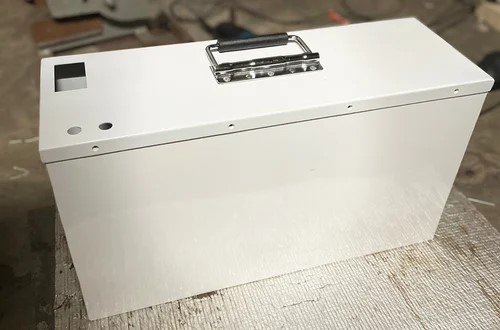
A compact battery pack enclosure is a lightweight, handle-integrated Li-Ion battery housing designed for swap-able EV 2-wheelers, last-mile delivery bikes, and portable energy storage. KM Engineering fabricates these in Faridabad from 1.6–2.0 mm CRCA or SS 304 steel with IP54/IP65 ratings, integrated carry handles, cam-locks and Anderson/XT connector cut-outs — MOQ 10 units and 12-day typical lead time.
What Is Compact Battery Pack Enclosure?
A compact battery pack enclosure is a Li-Ion battery housing optimized for portability, swap-ability and low weight — typically under 12 kg including the fitted cells. It is used in battery-swap networks for electric 2-wheelers, last-mile delivery fleets, portable power stations, and mobile telecom backup. The design priorities are ergonomic carry handles, quick-release locks, drop-tolerant structure, and fast thermal dissipation.
KM Engineering produces compact battery pack enclosures for swap-station operators, 2W EV OEMs and delivery fleet aggregators across India. Our designs support 48 V / 51.2 V / 60 V pack formats with capacities from 1.5 kWh to 3.5 kWh. The housings are fabricated from 1.6–2.0 mm CRCA steel or 1.5 mm SS 304 using fiber-laser cutting, CNC press-brake bending and TIG/MIG welding — finished with a durable 60–80 µm powder coat.
Every compact enclosure ships with customer-specified connector cut-outs (Anderson SB50/SB120, XT-90, AMP Superseal or OEM-specific), lockable carry handle, and optional RFID/smart-lock cut-outs for authenticated swap networks. We supply to 15+ EV 2W brands and swap-station operators from our Badkhal Road, Faridabad facility.
Detailed Specifications
Full technical specifications for Compact Battery Pack Enclosure — material grades, tolerances, process capabilities, and standards compliance.
| Specification | Value / Description |
|---|---|
| Material Grade | IS 513 CRCA / IS 6911 SS 304 |
| Sheet Thickness | 1.6 mm / 2.0 mm (CRCA); 1.5 mm (SS 304) |
| Typical Overall Envelope | 350 × 200 × 180 mm up to 450 × 250 × 220 mm (size-variable) |
| Target Empty Weight | 2.5 – 5 kg depending on size and material |
| Cutting Tolerance | ± 0.1 mm (fiber-laser) |
| Bending Tolerance | ± 0.5° angular, ± 0.2 mm linear |
| Welding | TIG (GTAW) for SS; MIG (GMAW) for CRCA |
| Handle | Integrated fold-flat handle, stamped + welded; rated 25 kg static |
| Lock Provision | Cam-lock, key-lock, or RFID-activated electromagnetic lock cut-outs |
| Connector Options | Anderson SB50 / SB120, XT-90, AMP Superseal, custom cable-gland (M20/M25) |
| Ingress Protection | IP54 standard; IP65 with gasket + breather vent |
| Gasket | Closed-cell EPDM 3 mm (IP65 option) |
| Drop Test Design Target | 1 m free-fall onto concrete — no functional damage (design intent) |
| Vibration Design Target | Aligned with IS 16270 / IEC 60068-2-6 random vibration — 5–500 Hz |
| Standard Finish Colors | Matte Black RAL 9005, Grey RAL 7035, Safety Yellow RAL 1023 |
| Branding | Screen-print, pad-print, or laser-etched logo |
| Mounting / Docking | Spring-pin docking rails, magnetic catch, or floor-clamp options |
Manufacturing Process
How KM Engineering fabricates Compact Battery Pack Enclosure — step-by-step process from drawing review to dispatch.
Design & Ergonomic Review
We validate handle ergonomics, lock placement, cell-group access, and connector reach against typical user carry-and-dock patterns. Output: approved 2D drawings and 3D STEP model.
Laser Cutting
Fiber-laser cut with tight kerf (~0.15 mm) to preserve tight connector and lock pocket dimensions. Nest utilization target > 75%.
Bending & Forming
CNC press-brake bending per sequenced program; formed handle recesses and stiffening ribs where needed.
TIG/MIG Welding
Handle and docking features welded first, then structural seams. Anti-spatter gel used on CRCA; full penetration on load-bearing handle weld.
Deburring & Surface Prep
Mechanical deburr + grind on welded areas; full 7-tank pre-treatment before coating.
Powder Coating
Epoxy-polyester powder coat, cured at 180–200 °C for 15–20 minutes. Adhesion verified by cross-hatch test per batch.
Gasket & Hardware Fitment
EPDM gasket bonded into lid channel (IP65 variant); cam-lock or RFID module fitted per BOM; connector bulkheads mounted.
Functional QC — Handle Pull, Lock Cycle, Drop Simulation
Handle pull test (2× rated load), 500-cycle lock actuation, drop-simulation on sample batches; 100% visual QC on production.
Kitting & Dispatch
Individual carton pack with internal foam tray; DC + GST invoice + material TC on request; dispatch same day as QC clearance.
Request a Quote for Compact Battery Pack Enclosure
Share your drawings or requirements — we respond within 24 hours with a DFM review and priced offer.
Standards & Compliance
KM Engineering manufactures Compact Battery Pack Enclosure in alignment with the following Indian and international standards:
- IEC 60529 — IP ratings (IP54 / IP65)
- IEC 60068-2-6 — Environmental vibration test reference
- IS 513 — CRCA grade
- IS 6911 — Stainless steel grade
- ASTM D3359 — Coating adhesion
- ISO 9001:2015 — QMS alignment
Industries & Applications
Compact Battery Pack Enclosure by KM Engineering is used across multiple Indian industries. Below are typical buyers, their applications, and why they choose us:
EV 2-Wheeler Swap Networks
Application: Standardized 48 V / 51.2 V swap packs dropped into rider-swap stations
Why KM: Light (< 5 kg empty), consistent overall dimensions within ± 1 mm for reliable docking, RFID-lock ready
Last-Mile Delivery Fleets
Application: Quick-swap batteries for food, grocery and parcel delivery bikes
Why KM: Drop-tolerant design, fast handle ergonomics for 100+ swaps/day per bike
Portable Power Stations
Application: Consumer and light-commercial portable lithium power stations
Why KM: Branded cosmetic finish available, integrated carry handle, multiple connector cut-outs (AC inverter + DC outputs)
Telecom Site Spare Batteries
Application: Hot-spare lithium packs stored at cell tower sites for emergency swap
Why KM: IP65 outdoor-rated with robust lock for unattended tower-site storage
Medical / Field Equipment
Application: Portable diagnostic carts, solar mini-clinics, field medical kits
Why KM: SS 304 option for hygienic wipe-down, rounded internal corners, low EMI signature
Customization Options
Every Compact Battery Pack Enclosure we fabricate is made to the customer's drawing or specification. Customizable aspects include:
- Size and envelope — any OEM or swap-station spec, typical 350×200×180 mm to 450×250×220 mm
- Voltage class — 24 V, 36 V, 48 V, 51.2 V, 60 V, 72 V
- Connector — Anderson SB-series, XT-90, AMP Superseal, M20/M25 cable glands, custom OEM connectors
- Lock — mechanical cam lock, tubular key lock, RFID electromagnetic, Bluetooth smart-lock cut-out
- Handle — fixed steel, fold-flat, rotating, strap-style, rubber-overmolded
- Indicators — SoC LED strip cut-outs, LCD window openings
- Docking — spring-pin rails, dovetail slides, magnetic catches, floor-clamp brackets
- Branding — silkscreen, pad-print, laser etch, riveted aluminum ID plate
Quality Assurance & Testing
Each Compact Battery Pack Enclosure undergoes the following QC steps as part of our ISO 9001:2015-aligned quality system:
- 100% dimensional check on handle, lock and connector cut-out positions
- Handle pull test on first-article and per-batch sample — 2× rated carry load held 60 s
- Lock actuation cycle test — 500 cycles on first-article
- Drop simulation — 1 m onto concrete, 3 orientations (first-article only)
- IP-rating spray or dust test on IP65 samples — per customer PPAP
- Powder-coat adhesion and thickness per batch
- 100% visual QC and packaging check before dispatch
How We Compare
Here is how KM Engineering's Compact Battery Pack Enclosure compares against alternative supplier options available to Indian buyers:
| Criterion | KM Engineering | Generic Steel Fabricator | Plastic / Hybrid Enclosure |
|---|---|---|---|
| Empty Weight (48V size) | 2.5 – 5 kg | 5 – 8 kg (generic steel) | 1.8 – 3.5 kg (aluminum/plastic hybrid) |
| Handle Load Capacity | 2× rated @ 60 s | Rated only | Often rated only; plastic creep risk |
| Lead Time | 10–12 days prototype | 30–45 days | 15–20 days |
| Custom Connector Support | Any OEM connector | Catalog options | Limited |
| IP Rating | IP54 std / IP65 opt | IP54 typical | IP54 / IP65 available |
| Cosmetic Finish Quality | 60–80 µm powder, batch-tested adhesion | Standard spray paint | Molded color (plastic) |
| Repairability / Serviceability | Bolted + gasketed — fully serviceable | Usually serviceable | Glued plastic — limited |
Ordering & Lead Time
Frequently Asked Questions
How light can you make a compact battery enclosure?
For a typical 48 V / 1.5–2.0 kWh swap-pack envelope (~400 × 220 × 180 mm), the empty enclosure weight is 2.5–4.0 kg in 1.6 mm CRCA and 2.2–3.5 kg in 2.0 mm aluminum 5052. Lower weights are achievable with cutouts and ribbing optimization — share your target and we'll quote a DFM-optimized design.
Do you support RFID-locked swap networks?
Yes. We provide cut-outs and mounting pockets for OEM-specified RFID electromagnetic locks, Bluetooth smart-locks, or mechanical cam locks. We typically source the lock assembly through the customer's BOM, or we can source common modules under a linked supply arrangement.
What connector options do you support?
All common EV swap connectors: Anderson SB50/SB120, XT-90, AMP Superseal, Deutsch DT-series, and OEM-specific cable glands (M20/M25). We cut the bulkhead opening to drawing, and fit customer-supplied or sourced connectors as required.
Can the enclosure be made in aluminum for weight saving?
Yes. 2.0 mm aluminum 5052 H32 is a common alternative that saves ~30% weight vs 1.6 mm CRCA for the same panel. Aluminum enclosures require TIG welding and anodizing or powder coating; lead time is typically 2–3 days longer than the CRCA equivalent.
What is the typical IP rating achievable on a compact swap pack?
IP54 is standard and is sufficient for most indoor and sheltered outdoor swap stations. IP65 is achievable via closed-cell gasketing on the lid interface and breather-vent on cell compartment — recommended for unsheltered outdoor swap stations.
Do you offer drop and vibration testing?
We do design for drop and vibration per IEC 60068-2-6 random-vibration and conduct in-house drop-simulation on first-article samples (1 m concrete drop, 3 orientations). Full certified drop/vibration testing is available at partner labs (ICAT, ARAI, ERTL) on PPAP projects.
What is the cost difference between CRCA and SS 304 options?
SS 304 typically adds 35–55% to the material cost vs CRCA for the same thickness, plus TIG welding is slower than MIG. For a compact 48 V enclosure, expect 30–45% higher total unit cost for SS 304. SS is chosen when corrosion-resistance, hygiene, or cosmetic stainless finish are required.
Do you supply branded cosmetic finish enclosures?
Yes. We offer silkscreen and pad-printed logos, laser-etched branding, and riveted aluminum ID plates. For fully cosmetic product (e.g., consumer portable power stations), we apply higher-grade 80 µm powder coat with color-matched RAL and optional clear-coat sealing.
Are there any volume discounts?
Yes. Pricing tiers typically break at 50, 200, 500, 1000 and 5000 units. For recurring supply arrangements and VMI (vendor-managed inventory), we offer additional rate-card pricing.
Related Products
Other products frequently considered alongside Compact Battery Pack Enclosure:
Ready to Source Compact Battery Pack Enclosure?
Share your drawings or requirements with KM Engineering. Our Faridabad team responds within 24 hours with a DFM review, lead time and priced offer.