Quick Answer
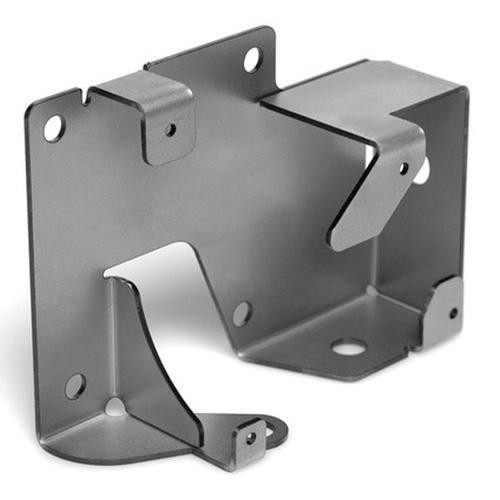
CNC press brake bending is a sheet-metal forming process where a hydraulic or electric press brake, guided by a CNC controller, bends flat blanks into precise 3D shapes using matched die and punch tooling. KM Engineering offers CNC press brake bending jobwork in Faridabad — ± 0.5° angular tolerance, 0.5–6 mm sheet thickness, up to 3000 mm bend length, custom tooling for complex profiles, and same-day quoting for standard jobs.
What Is CNC Press Brake Bending Service?
CNC press brake bending is the process of bending sheet-metal blanks into accurate 3D profiles by pressing the sheet between a V-die (lower tool) and a punch (upper tool) with CNC-controlled ram depth, back-gauge position, and bend sequence. Modern CNC press brakes deliver angular tolerance of ± 0.5° or better and linear positional tolerance of ± 0.2 mm — far superior to manual brake bending and consistently repeatable across hundreds or thousands of parts.
KM Engineering's CNC press brake bending jobwork takes laser-cut blanks (customer-supplied or cut by our laser service) and bends them per your drawing. Our machine park includes CNC press brakes up to 3000 mm bed length, supporting sheet thicknesses from 0.5 mm up to 6 mm in CRCA, stainless, and aluminum. We stock standard V-die tooling (V6, V10, V12, V16, V20, V25 mm) and manufacture custom tooling for specialized profiles — U-channels, Z-profiles, hemmed edges, box-bends, and tight-radius forms.
The bending jobwork service complements our laser-cutting jobwork: many customers send us a DXF, we cut and bend, and they collect fully-formed blanks ready for welding or assembly. We also accept customer-cut blanks for bending-only work. Typical jobs include: machine covers and guards, electrical enclosure bodies, mounting brackets, equipment housings, chassis formings, ductwork and tray shapes, and decorative architectural metalwork.
Detailed Specifications
Full technical specifications for CNC Press Brake Bending Service — material grades, tolerances, process capabilities, and standards compliance.
| Specification | Value / Description |
|---|---|
| Bed Length Capacity | Up to 3000 mm |
| Material Range | CRCA (IS 513), GI, SS 304/316/430 (IS 6911), Aluminum (IS 733) |
| Thickness — CRCA | 0.5 – 6 mm |
| Thickness — SS 304/316 | 0.5 – 4 mm (routine), 5 mm with correct tooling |
| Thickness — Aluminum | 0.5 – 4 mm |
| Angular Tolerance | ± 0.5° on bend-to-bend (typical); ± 0.3° achievable with care |
| Linear Tolerance (position) | ± 0.2 mm on back-gauge positioned features |
| Minimum Inside Bend Radius | 0.8× to 1.2× sheet thickness (material-dependent) |
| Standard V-Die Set | V6 / V10 / V12 / V16 / V20 / V25 mm — selection based on thickness |
| Punch Set | Standard, gooseneck, acute-angle, offset, and hemming punches |
| Custom Tooling | Designed and manufactured in-house for specialty profiles |
| Bend Types Supported | 90°, acute, obtuse, U-channel, box-bend, hem, offset, stepped |
| Complex Profile Support | Multi-bend programs, gauge-change during cycle |
| Springback Compensation | Programmed into CNC for consistent angle |
| Minimum Flange Length | Roughly 3–4× sheet thickness (tooling-dependent) |
| Typical Part Weight Handled | Up to 50 kg single operator; heavier with tandem support |
| Marking / Branding | Pre-bend parts can be laser-scribed with part ID |
| Setup Time (standard tooling) | 10–20 minutes; custom tooling setup 30–60 minutes |
Manufacturing Process
How KM Engineering fabricates CNC Press Brake Bending Service — step-by-step process from drawing review to dispatch.
Drawing Review & DFM
Drawing checked for bend reliefs (critical — avoids corner tearing), bend sequence feasibility (avoid tooling interference), minimum flange length, and bend radius vs material thickness. DFM feedback within 24 hours.
Bend Sequence Programming
CNC program written — bend order chosen to avoid punch/die interference and back-gauge clashes on subsequent bends. Complex parts may require tooling change between bends.
Tooling Setup
V-die and punch selected per material thickness (standard rule: V-width = 6–8× thickness). Custom tooling installed if required for special profile.
Blank Verification
Laser-cut blank checked against flat-pattern drawing — overall size, bend-line positions, relief-cut presence, orientation marks (if any).
Trial Bend & First-Article
First part bent and measured against drawing — angle, flange length, overall envelope. Springback corrected on CNC if needed. First-article approved before full run.
Production Bending
Parts bent per program. Operator monitors each part for orientation errors, marking defects, and bend-count errors. Every Nth part sampled for dimensional check.
Dimensional QC
100% angle check on small-lot production; sampling basis on large lot (AQL 1.5). Overall envelope verified on first-article and at shift changes.
Post-Bend Handling & Dispatch
Bent parts stacked on pallets or in custom totes to protect finish; dispatched same day or next day after completion.
Request a Quote for CNC Press Brake Bending Service
Share your drawings or requirements — we respond within 24 hours with a DFM review and priced offer.
Standards & Compliance
KM Engineering manufactures CNC Press Brake Bending Service in alignment with the following Indian and international standards:
- DIN 6935 — Cold bending of steel
- IS 513 / IS 6911 / IS 733 — Material grades
- ISO 9001:2015 — QMS alignment
Industries & Applications
CNC Press Brake Bending Service by KM Engineering is used across multiple Indian industries. Below are typical buyers, their applications, and why they choose us:
Sheet Metal Fabricators
Application: Outsourcing bending when their in-house brake is booked or tooling is inadequate
Why KM: Flexible tooling access; drop-blank/collect-bent-parts workflow; same-day turnaround possible
OEM Machine Builders
Application: Bending of enclosure bodies, covers, brackets, hoppers, chutes — single parts to production lots
Why KM: Tight tolerance for assembly fit-up; custom tooling available for OEM-specific profiles
EV & Hardware Startups
Application: Prototype bending of chassis parts, battery box panels, brackets; iterative design changes
Why KM: 1-part MOQ, fast revision, affordable iteration during early-stage product development
HVAC & Ductwork
Application: Bending of ventilation ducts, exhaust hoods, plenum boxes, flanges, transitions
Why KM: Long-bed capacity (3000 mm) for large duct sections; hemmed-edge tooling for safe-edge requirement
Electrical Panel Builders
Application: Bending of cabinet bodies, mounting plates, cable-gland covers, door flanges
Why KM: Precision bend-line positioning for panel door fit-up; branded OEM-specific tooling possible
Architectural Metalwork
Application: Bending of facade panels, trim, flashings, channel letters, decorative forms
Why KM: Cosmetic-grade surface preservation during bending; soft-top tooling for polished stainless
White Goods & Appliance
Application: Body panels, inner liners, trim, brackets for home appliances
Why KM: Mid-volume production (100–5000 units) cost-effective; supports multi-bend complex profiles
Customization Options
Every CNC Press Brake Bending Service we fabricate is made to the customer's drawing or specification. Customizable aspects include:
- Tooling — standard V-die sets or custom tooling for specialty profiles
- Bend radius — from minimum (1× thickness) to large-radius rolled-form equivalents
- Complex multi-bend — up to 8+ bends per part with programmed sequence
- Hemmed edges — safe-edge hem, open hem, closed hem
- Offset bends — Z-bends, U-channels, stepped forms
- Thick-sheet bending — up to 6 mm CRCA, 4 mm SS, 4 mm aluminum
- Surface protection — urethane die pads for polished-SS parts; soft-top tooling for pre-coated material
Quality Assurance & Testing
Each CNC Press Brake Bending Service undergoes the following QC steps as part of our ISO 9001:2015-aligned quality system:
- First-article dimensional check — angles, flange lengths, envelope
- Sampling-basis angle verification during production
- Visual check for marking, scratching, or tool marks
- Overall envelope verification before dispatch
- Shift-change re-check on long production runs
How We Compare
Here is how KM Engineering's CNC Press Brake Bending Service compares against alternative supplier options available to Indian buyers:
| Criterion | KM Engineering | Manual Brake Shop | Premium Large-Bed CNC Shop |
|---|---|---|---|
| Angular Tolerance | ± 0.5° typical | ± 1–2° (manual brake) | ± 0.3° (premium CNC) |
| Max Bend Length | 3000 mm | 1000–2000 mm (smaller shops) | 4000+ mm (large shops) |
| MOQ | 1 part | Varies | High-volume only |
| Custom Tooling | In-house manufacture | Limited | In-house |
| Quote Turnaround | Same day | 1–3 days | 2–5 days |
| Setup Time (standard) | 10–20 min | 20–30 min | 10–15 min |
Ordering & Lead Time
Frequently Asked Questions
What's the tightest angular tolerance you can achieve?
Our typical angular tolerance is ± 0.5° on bend-to-bend. With careful setup, material batching, and springback correction, we can achieve ± 0.3° on critical features — particularly on clean CRCA sheet with consistent mill properties. For tighter tolerance (± 0.1°), post-bend straightening or tooling upgrade is needed.
Can you bend parts up to 3 meters long?
Yes — our longest press brake bed is 3000 mm. Long parts require careful support and may need a tandem operator or overhead crane lifting assist. Sheet weight is the practical constraint — a 3000×1500×3 mm CRCA sheet weighs ~106 kg and requires support handling.
What's the minimum inside bend radius?
Roughly 1× sheet thickness as a baseline — so 2 mm inside radius for 2 mm CRCA. Tighter radii (0.8× thickness) are achievable with matched tooling but risk outer-fiber cracking on harder materials. For aluminum, minimum radius depends on temper: H32 bends tighter than H34.
Do you provide custom bending tooling?
Yes. For specialty profiles — hemmed edges, Z-bends, U-channels, multi-step forms, radiused forms — we design and manufacture custom tooling in-house. Custom tooling cost is amortized against production quantity; for one-off prototypes we may use standard tooling with workarounds or refer to soft-tool partners.
Can you bend pre-coated or polished stainless without marking?
Yes. We use urethane-faced die pads and protective film for polished stainless and pre-painted surfaces. This protects the cosmetic finish during bending but may slightly increase setup time. Specify 'protect finish' on your order for the appropriate handling.
What about bending thick plate (8 mm, 10 mm)?
Our in-house capacity is 6 mm CRCA. For 8–12 mm plate bending, we partner with a large-bed heavy press brake facility; partner work adds 3–5 days to lead time. For < 25 mm plate, hot-roll forming or hydraulic rolling is often a better process than brake bending.
Can you handle multi-bend complex parts with tight sequence constraints?
Yes. Our CNC controller handles 6-axis back-gauge and multi-step programs. Complex parts with 8+ bends and interference-prone sequences are routinely processed. For truly complex parts we simulate the bend sequence in CAM to validate no-clash operation before production.
Do you accept bending-only work (customer-supplied blanks)?
Yes. Customer-cut blanks are welcome — send blanks with the drawing and we bend per spec. We check blank dimensions, bend-line positions, and relief cuts before bending; if the blanks are misdimensioned or relief cuts are missing, we flag and await approval before proceeding.
How do you handle springback?
Springback is programmed into the CNC based on material (grade + thickness + batch) and tooling. First-article trial confirms the programmed compensation; minor adjustments are made if needed. For high-spring materials (fully-hard SS, work-hardened aluminum), we may need 2–3 trial bends to dial in.
What's the cost model — per bend, per part, or per hour?
Per-part pricing is standard for jobwork — factored on bend count, part complexity, setup time, and quantity. Simple 2-bend brackets: INR 8–25 per bend depending on thickness. Complex multi-bend parts: quoted per part based on full time estimate. Send your drawing for a specific quote — same-day response.
Can you bend and weld in the same job?
Yes. Our full fabrication facility handles cut + bend + weld + finish as a single job. Many customers send a drawing and receive fully-fabricated parts ready for assembly. This end-to-end workflow often saves 2–5 days vs sending between specialist shops.
Related Products
Other products frequently considered alongside CNC Press Brake Bending Service:
Ready to Source CNC Press Brake Bending Service?
Share your drawings or requirements with KM Engineering. Our Faridabad team responds within 24 hours with a DFM review, lead time and priced offer.